Well, sound like Michael Hudson was right:
"... Foreign countries are beginning to treat dollars as “hot potatoes,” trying to get rid of them as fast as they can.
But how can they all do this? China is using its new dollar inflows to try and buy up foreign raw materials assets, land and other assets needed for its long-term growth. And some Middle Eastern countries are buying long-term supply agreements for food and raw materials produced abroad."
From Reuters:
BEIJING, Dec 29 (Reuters) - China plans to use the fall in global energy demand to boost its fledgling oil reserves against future supply shocks, as it speeds up development of nuclear and wind power and cuts reliance on coal, a top energy official said.
Setting out the nation's policy responses to the global economic crisis in an unusually detailed exposition of its energy strategy, Zhang Guobao, head of the National Energy Administration, said:
"The severity of the economic downturn has brought a marked decline in demand for oil and unprecedented pressure on prices. The amount of crude oil on the international market still far exceeds global demand."
In his article published on Monday in the official People's Daily newspaper, Zhang wrote that the global downturn had posed serious challenges to China's energy sector but also brought a rare chance to make adjustments.
Among the plans, China will push ahead with building the second phase of its strategic oil reserves, having largely completed the first, Zhang said.
That could increase import demand and help global crude oil prices to get into forward gear, having been stuck in reverse since hitting a record high in July.
The government has not disclosed if it has fully filled the first phase of tank farms, which were set up in four locations and can hold 102 million barrels, equivalent to 29 days of crude imports, based on average net trade so far this year.
The first two bases, at Zhenhai and Zhoushan, were up and running more than a year ago. Construction of the Dalian facility, the fourth base, was due for completion by year-end.
Although it was unclear if "completion" referred to building or filling tanks, Zhang's words lent credence to signs that China had at least started filling its third base, at Huangdao.(...)
A GLIMPSE OF STOCKING
China has completed planning of the second phase of government storage facilities that could hold up to 26.8 million cubic metres of oil, or some 170 million barrels, but has not disclosed where the facilities are or whether construction has begun.
The size of China's storage will still be a fraction of the U.S. Strategic Petroleum Reserve(!!), the world's largest emergency oil stockpile, which holds 700 million barrels of crude.
But China is second only to the United States as a consumer of oil and its rapid stockpiling effort, begun only two years ago, has the potential to soak up a lot of surplus crude oil.
China is also shopping for strategic metals such as aluminium and indium and is supporting farmers by buying up crops. But officials have said little about buying oil, aside from vague remarks that China could buy up "resources and materials".
(...) The country would also encourage its oil firms to use spare storage capacity to increase commercial stockpiling of oil resources, Zhang said.
Last week top state oil firm PetroChina began filling its new Shanshan facility in the northwestern Xinjiang region with Kazakh oil, while its rival Sinopec finished building tanks in the coastal Zhejiang province.
Private fuel traders, long living under the shadow of the oil duopoly because they are short of independent fuel supplies, have also indicated they are interested in storing government oil, state media has reported.
Zhang also said China would push on with plans for pipelines from Kazakhstan and Myanmar, though he did not mention increasing imports from Russia, which wants to build oil and gas pipelines from East Siberia and is locked in talks with PetroChina's parent CNPC about a loans-for-oil deal.
Among its other plans to push for energy development, China will start building four nuclear power stations next year -- two in Shandong, one in Zhejiang and one in Guangdong, Zhang said.
Two stations are supposed to adopt technologies from U.S.-based, Japanese-owned Westinghouse and one from France's Areva, earlier plans showed.
Here IbnBattuta: to say that China oil storage will be a fraction of U.S. Strategic Petroleum Reserve is misleading(at best).
The important thing about reserves is how many days of oil consumption they represent.
US reserves(727 million barrels) = 70 days
China reserves(272 millions) = 77 days
miércoles, 31 de diciembre de 2008

Extremism in the defense of liberty is no vice.... Moderation in the pursuit of justice is no virtue.
Asylum seekers tripled in Italy in the last three years(here the link, only in Italian) and there are no reasons whatsoever to expect it to be an Italian prerogative.
I cannot prove it but it seems unlikely that such a spike will not be matched by an increase in economis migrants.
More and more people, in the EU especially, worries about the deterioration in welfare's qualitity as a consequence of migration, too few seems to be concerned about civil liberties and democracy, not only in the EU but also in the US(here's a paper from CIS -Center for Immigration Studies).
Asylum seeker are not the only migrants that comes from illiberal, undemocratic if not openly repressive regimes. It's a lot harder to get out of poverty without an decently open society(although the meteoric ascent of China may have lead us to forget it).
These people are not reaching vibrant thriving and vital democracies.
They are reaching fragile systems, where political parties(the true intermediaries between institutions and citizens) have been loosing the critical mass of militans that either controls them and provide them a meaningfull feedback. Too many people never came to appreciate what use they could eventually give to many of those civil liberties.
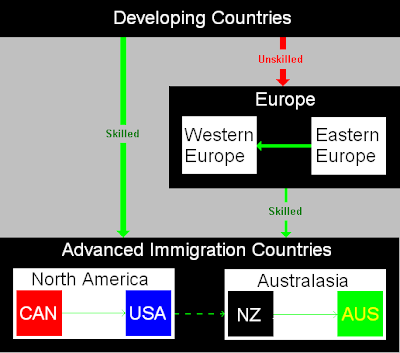
Here is a scheme that illustrate the principal patterns of international migrations included the brain drain problems that face Europe.
Democracy is built unto small daily choices, not great battles once in a while.
It's a use-it-or-loose-it process. A process that begin within each and any individual.
We cannot prove that religion is indispensable to democracy(let alone Western Monotheism) what we certainly know is that our ancestors used the idea of men created equals as an image of God to get rid of some economic privileges that had been there for centuries.
Since then we have experienced democracy in the form of a sense of entitlement, of collective ownership, in a moral way but also in according to private law, with different degrees of intensity according to the cultures and traditions.
The transparency and the openness, the shared belief that informations are there to be shared for public interest and not hidden and exploited for cliental purposes.
And yet it's yesterday news that the Mob in Italy use the constructors workers that they hire to influence the internal life of political parties wherever they bring them to work.
NeverEnding National Corruption Tour.
But that again is possible only because citizens spiritual strength has been weakened and their common sense of purpose wiped out.
The terms anomy has since long been a pathetic euphemism, a jargon for mandarin that hiddens more than it reveals.
Again that is typical of a society that is getting old.
I'm not being ageist. I agree with the African proverb. when an old man died a library is burnt.
But if we are all library, who will take the dust away from the books, who will read it, and, most important, who will write the new one?
The coming years of sluggish growth(here's Stephen Roach most recent outlook) are likely to further increase that historical migration trend.
A rapidly ageing population(median age above 40, fertility rate between 1.22 and 1.7, population growth rate 0.11) is likely to perceive it as a threat and not only accept but call for a kind of moratory in some individual liberties in exchange for an increased sense of security.
Again, an ageing society may not find especially bothersome that the government meddles in his sexual life, especially if they no longer have one.
Here's is an article about Section 63 of the Criminal Justice and Immigration Act.
I've never thought I'll see the day in which I'd have spoken out in favour of Britain's BDSM (bondage, domination and sado-masochism) community.
For a person that chose IbnBattuta as a pseudonym it's quite an astonishing call, isn'it?
Again, a society of old tech-illiterate, the kind of controls on the web that Labour recently tried to implement are likely to be tolerable and even urgent. Here's the FT techblog
The recent arrest of MP Damien Green, shadow immigration minister was also unprecedent.
William Buiter makes clear points here, and have another important post here(sleepwalking into a police state)
As that great conservative, Barry Goldwater said:
Extremism in the defense of liberty is no vice.... Moderation in the pursuit of justice is no virtue.
I cannot prove it but it seems unlikely that such a spike will not be matched by an increase in economis migrants.
More and more people, in the EU especially, worries about the deterioration in welfare's qualitity as a consequence of migration, too few seems to be concerned about civil liberties and democracy, not only in the EU but also in the US(here's a paper from CIS -Center for Immigration Studies).
Asylum seeker are not the only migrants that comes from illiberal, undemocratic if not openly repressive regimes. It's a lot harder to get out of poverty without an decently open society(although the meteoric ascent of China may have lead us to forget it).
These people are not reaching vibrant thriving and vital democracies.
They are reaching fragile systems, where political parties(the true intermediaries between institutions and citizens) have been loosing the critical mass of militans that either controls them and provide them a meaningfull feedback. Too many people never came to appreciate what use they could eventually give to many of those civil liberties.
Here is a scheme that illustrate the principal patterns of international migrations included the brain drain problems that face Europe.
Democracy is built unto small daily choices, not great battles once in a while.
It's a use-it-or-loose-it process. A process that begin within each and any individual.
We cannot prove that religion is indispensable to democracy(let alone Western Monotheism) what we certainly know is that our ancestors used the idea of men created equals as an image of God to get rid of some economic privileges that had been there for centuries.
Since then we have experienced democracy in the form of a sense of entitlement, of collective ownership, in a moral way but also in according to private law, with different degrees of intensity according to the cultures and traditions.
The transparency and the openness, the shared belief that informations are there to be shared for public interest and not hidden and exploited for cliental purposes.
And yet it's yesterday news that the Mob in Italy use the constructors workers that they hire to influence the internal life of political parties wherever they bring them to work.
NeverEnding National Corruption Tour.
But that again is possible only because citizens spiritual strength has been weakened and their common sense of purpose wiped out.
The terms anomy has since long been a pathetic euphemism, a jargon for mandarin that hiddens more than it reveals.
Again that is typical of a society that is getting old.
I'm not being ageist. I agree with the African proverb. when an old man died a library is burnt.
But if we are all library, who will take the dust away from the books, who will read it, and, most important, who will write the new one?
The coming years of sluggish growth(here's Stephen Roach most recent outlook) are likely to further increase that historical migration trend.
A rapidly ageing population(median age above 40, fertility rate between 1.22 and 1.7, population growth rate 0.11) is likely to perceive it as a threat and not only accept but call for a kind of moratory in some individual liberties in exchange for an increased sense of security.
Again, an ageing society may not find especially bothersome that the government meddles in his sexual life, especially if they no longer have one.
Here's is an article about Section 63 of the Criminal Justice and Immigration Act.
I've never thought I'll see the day in which I'd have spoken out in favour of Britain's BDSM (bondage, domination and sado-masochism) community.
For a person that chose IbnBattuta as a pseudonym it's quite an astonishing call, isn'it?
Again, a society of old tech-illiterate, the kind of controls on the web that Labour recently tried to implement are likely to be tolerable and even urgent. Here's the FT techblog
The recent arrest of MP Damien Green, shadow immigration minister was also unprecedent.
William Buiter makes clear points here, and have another important post here(sleepwalking into a police state)
As that great conservative, Barry Goldwater said:
Extremism in the defense of liberty is no vice.... Moderation in the pursuit of justice is no virtue.
martes, 30 de diciembre de 2008
Stephen Roach interviewed by Caijing
#1 (youtube link)
-Shape of the recession: a flat U
-American consumers: weakest most fragile states we have seen in the post war.
-Early stages of a multi year ajustment for american consumers
-Sluggish global growth for 3 to 5 years
-No Great Depression, Great Stagnation instead
#2 (youtube link)
-American consumers too far, too fast, for too long - limited recovery at best
-Consume less, create incentive to save more and reinvest in infrastructures
-TARP isn't working
#3 (youtube link)
-Inflation vs. Deflation outlook for 2009
-Reasons why china is buying US treasuries
-Falling chinese export
-The need for a safety net in China.
Ecuador: Judge could order Chevron Corp., which now owns Texaco, to pay as much as $27 billion in damages.
Here's a (slightly edited)abstract from a Bloomberg very exhaustive article:
"About 230,000 people live in Ecuador’s northeastern rain forest side by side with oil wells and pools of drilling waste. A gasolinelike smell hangs in the sweltering jungle air. The mess is a remnant of oil drilling in a 120-mile-long swath of the tropical jungle in northeastern Ecuador where Texaco Inc. and Ecuador’s state-run oil company, PetroEcuador, have pumped billions of barrels of crude from the ground during the past 40 years.
That ruined land is part of one of the worst environmental and human health disasters in the Amazon basin, which stretches across nine countries and, at 1.9 billion acres (800 million hectares), is about the size of Australia.
Depending on how an Ecuadorean judge rules in a lawsuit over the pollution, it may become the costliest corporate ecological catastrophe in world history.
If the judge follows the recommendation of a court- appointed panel of experts, he could order Chevron Corp., which now owns Texaco, to pay as much as $27 billion in damages.
Chevron says Texaco had completely cleaned up its mess by 1998. PetroEcuador, which took over Texaco’s operations in 1990 -- and not Texaco -- is to blame for today’s pollution, Chevron says.
From 1990 until 2007, government-owned PetroEcuador released wastewater into the environment, says Fausto Meja, a spokesman for PetroEcuador. He says the company has spent the past 16 years cleaning up, decreasing its dumping each year. It stopped releasing waste entirely by 2008, he says.
The case will be decided in an old concrete building in the Amazonian oil town of Lago Agrio, 37 miles (60 kilometers) north of Cevallos’s former home. With a shoe store, a T-shirt shop and a beauty salon on the street level, the building, which has no elevator, also houses a provincial courthouse.
Here's a Gregg Palast interview with Ecuador's President, Rafael Correa (Ph.D. in Economics at the University of Illinois at Urbana-Champaign). Please take cultural differences into accout, otherwise President Correa over the top boby language will make his country's claim an hard sell. Here's part1 and part2 of Gregg Palast Ecuador Rumble in the Jungle.
Benny Morris and Tariq Alí
Benny Morris' op-ed from NYT, here some abstracts:
"MANY Israelis feel that the walls — and history — are closing in on their 60-year-old state, much as they felt in early June 1967, just before Israel launched the Six-Day War and destroyed the Egyptian, Jordanian and Syrian armies in Sinai, the West Bank and the Golan Heights.
(...)
Israelis, or rather, Israeli Jews, are beginning to feel much the way their parents did in those apocalyptic days. Israel is a much more powerful and prosperous state today. In 1967 there were only some 2 million Jews in the country — today there are about 5.5 million — and the military did not have nuclear weapons. But the bulk of the population looks to the future with deep foreboding.
The foreboding has two general sources and four specific causes. The general problems are simple. First, the Arab and wider Islamic worlds, despite Israeli hopes since 1948 and notwithstanding the peace treaties signed by Egypt and Jordan in 1979 and 1994, have never truly accepted the legitimacy of Israel’s creation and continue to oppose its existence.
Second, public opinion in the West (and in democracies, governments can’t be far behind) is gradually reducing its support for Israel as the West looks askance at the Jewish state’s treatment of its Palestinian neighbors and wards. The Holocaust is increasingly becoming a faint and ineffectual memory and the Arab states are increasingly powerful and assertive.
More specifically, Israel faces a combination of dire threats.
To the east, Iran is frantically advancing its nuclear project.
To the north, the Lebanese fundamentalist organization Hezbollah, which also vows to destroy Israel and functions as an Iranian proxy, has thoroughly rearmed since its war with Israel in 2006. According to Israeli intelligence estimates, Hezbollah now has an arsenal of 30,000 to 40,000 Russian-made rockets, supplied by Syria and Iran — twice the number it possessed in 2006. Some of the rockets can reach Tel Aviv and Dimona, where Israel’s nuclear production facility is located. If there is war between Israel and Iran, Hezbollah can be expected to join in
To the south, Israel faces the Islamist Hamas movement, which controls the Gaza Strip and whose charter promises to destroy Israel and bring every inch of Palestine under Islamic rule and law. Hamas today has an army of thousands.
(...)But the attack will not solve the basic problem posed by a Gaza Strip populated by 1.5 million impoverished, desperate Palestinians who are ruled by a fanatic regime and are tightly hemmed in by fences and by border crossings controlled by Israel and Egypt.
The fourth immediate threat to Israel’s existence is internal.
It is posed by the country’s Arab minority. Over the past two decades, Israel’s 1.3 million Arab citizens have been radicalized, with many openly avowing a Palestinian identity and embracing Palestinian national aims.
(...) Demography, if not Arab victory in battle, offers the recipe for such a dissolution. The birth rates for Israeli Arabs are among the highest in the world, with 4 or 5 children per family (as opposed to the 2 or 3 children per family among Israeli Jews).
If present trends persist, Arabs could constitute the majority of Israel’s citizens by 2040 or 2050.
What is common to these specific threats is their unconventionality. Between 1948 and 1982 Israel coped relatively well with the threat from conventional Arab armies. Indeed, it repeatedly trounced them. But Iran’s nuclear threat, the rise of organizations like Hamas and Hezbollah that operate from across international borders and from the midst of dense civilian populations, and Israeli Arabs’ growing disaffection with the state and their identification with its enemies, offer a completely different set of challenges. And they are challenges that Israel’s leaders and public, bound by Western democratic and liberal norms of behavior, appear to find particularly difficult to counter.
Israel’s sense of the walls closing in on it has this past week led to one violent reaction. Given the new realities, it would not be surprising if more powerful explosions were to follow.
And Tariq Alí, from Counterpunch:
The assault on the Gaza Ghetto, planned over six months and executed with perfect timing was designed largely to help the incumbent parties triumph in the forthcoming Israeli elections. The dead Palestinians are little more than election fodder in a cynical contest between the Right and the Far Right in Israel. Washington and its EU allies, perfectly aware that Gaza was about to be assaulted, as in the case of Lebanon a few years, sit back and watch. Washington, as is its wont, blames the pro-Hamas Palestinians, with Obama and Bush singing from the same AIPAC hymn sheet.
The EU politicians, having observed the build-up, the siege, the collective punishment inflicted on Gaza, the targeting of civilians, etc [See Harvard scholar Sara Roy’s chilling essay in the latest LRB] were convinced that it was the rocket attacks that had ‘provoked’ Israel but called on both sides to end the violence, with nil effect. The moth-eaten Mubarik dictatorship in Egypt and NATO’s favourite Islamists in Ankara, failed to even register a symbolic protest by recalling their Ambassadors from Israel. China and Russia did not convene a meeting of the UNSC to discuss the crisis.
As result of official apathy, one outcome of this latest attack will be to inflame Muslim communities throughout the world and swell the ranks of those very organisations that the West claims it is combating in the ‘war against terror’.
The bloodshed in Gaza raises broader strategic questions for both sides, issues related to recent history. One fact that needs to be recognised is that there is no Palestinian Authority. There never was one. The Oslo Accords were an unmitigated disaster for the Palestinians, creating a set of disconnected and shrivelled Palestinian ghettoes under the permanent watch of a brutal enforcer.
The PLO, once the repository of Palestinian hope, became little more than a supplicant for EU money. Western enthusiasm for democracy stops when those opposed to its policies are elected to office. The West and Israel tried everything to secure a Fatah victory: Palestinian voters rebuffed the concerted threats and bribes of the ‘international community’ in a campaign that saw Hamas members and other oppositionists routinely detained or assaulted by the IDF, their posters confiscated or destroyed, us and EU funds channelled into the Fatah campaign, and US Congressmen announcing that Hamas should not be allowed to run. Even the timing of the election was set by the determination to rig the outcome. Scheduled for the summer of 2005, it was delayed till January 2006 to give Abbas time to distribute assets in Gaza—in the words of an Egyptian intelligence officer: ‘the public will then support the Authority against Hamas’. Popular desire for a clean broom after ten years of corruption, bullying and bluster under Fatah proved stronger than all of this.
Hamas’s electoral triumph was treated as an ominous sign of rising fundamentalism, and a fearsome blow to the prospects of peace with Israel, by rulers and journalists across the Atlantic world. Immediate financial and diplomatic pressures were applied to force Hamas to adopt the same policies as those whom it defeated at the polls.Uncompromised by the Palestinian
Authority’s combination of greed and dependency, the self-enrichment of its servile spokesmen and policemen, and their acquiescence in a ‘peace process’ that has brought only further expropriation and misery to the population under them, Hamas offered the alternative of a simple example. Without any of the resources of its rival, it set up clinics, schools, hospitals, vocational training and welfare programmes for the poor. Its leaders and cadres lived frugally, within reach of ordinary people. It is this response to everyday needs that has won Hamas the broad basis of its support, not daily recitation of verses from the Koran.
How far its conduct in the second Intifada has given it an additional degree of credibility is less clear. Its armed attacks on Israel, like those of Fatah’s Al-Aqsa Martyrs’ Brigade or Islamic Jihad, have been retaliations against an occupation far more deadly than any actions it has ever undertaken. Measured on the scale of IDF killings, Palestinian strikes have been few and far between. The asymmetry was starkly exposed during Hamas’s unilateral ceasefire, begun in June 2003, and maintained throughout the summer despite the Israeli campaign of raids and mass arrests, which followed, in which some three hundred Hamas cadres were seized from the West Bank. On 19 August 2003 a self-proclaimed ‘Hamas’ cell from Hebron, disowned and denounced by the official leadership, blew up a bus in West Jerusalem, upon which Israel promptly assassinated the Hamas ceasefire’s negotiator, Ismail Abu Shanab. Hamas in turn responded. In return, the Palestinian Authority and Arab states cut funding to its charities and, in September 2003, the EU declared the whole Hamas movement to be a terrorist organization—a long-standing demand of Tel Aviv.
What has actually distinguished Hamas in a hopelessly unequal combat is not dispatch of suicide bombers, to which a range of competing groups resorted, but its superior discipline—demonstrated by its ability to enforce a self-declared ceasefire against Israel over the past year. All civilian deaths are to be condemned, but since Israel is their principal practitioner, Euro-American cant serves only to expose those who utter it. Overwhelmingly, the boot of murder is on the other foot, ruthlessly stamped into Palestine by a modern army equipped with jets, tanks and missiles in the longest armed oppression of modern history. ‘Nobody can reject or condemn the revolt of a people that has been suffering under military occupation for forty-five years against occupation force’: the words of General Shlomo Gazit, former chief of Israeli military intelligence, in 1993.
The real grievance of the EU and US against Hamas is that it refused to accept the capitulation of the Oslo Accords, and has rejected every subsequent effort, from Taba to Geneva, to pass off their calamities on the Palestinians. The West’s priority ever since was to break this resistance. Cutting off funding to the Palestinian Authority is an obvious weapon with which to bludgeon Hamas into submission. Boosting the presidential powers of Abbas—as publicly picked for his post by Washington, as was Karzai in Kabul—at the expense of the Legislative Council is another.
No serious efforts were made to negotiate with the elected Palestinian leadership. I doubt if Hamas could have been rapidly suborned to Western and Israel but it would not have been unprecedented. Hamas’s programmatic heritage remains mortgaged to the most fatal weakness of Palestinian nationalism: the belief that the political choices before it are either rejection of the existence of Israel altogether, or acceptance of the dismembered remnants of a fifth of the country. From the fantasy maximalism of the first to the pathetic minimalism of the second, the path is all too short, as the history of Fatah has shown. The test for Hamas is not whether it can be house-trained to the satisfaction of Western opinion, but whether it can break with this crippling tradition. Soon after the Hamas victory I was asked in public by a Palestinian what I would do in their place. ‘Dissolve the Palestinian Authority’, was my response and end the make-belief. To do so would situate the Palestinian national cause on its proper basis, with the demand that the country and its resources be divided equitably, in proportion to two populations that are equal in size—not 80 per cent to one and 20 per cent to the other, a dispossession of such iniquity that no self-respecting people will ever submit to it in the long run. The only acceptable alternative is a single state for Jews and Palestinians alike, in which the exactions of Zionism are repaired.
"MANY Israelis feel that the walls — and history — are closing in on their 60-year-old state, much as they felt in early June 1967, just before Israel launched the Six-Day War and destroyed the Egyptian, Jordanian and Syrian armies in Sinai, the West Bank and the Golan Heights.
(...)
Israelis, or rather, Israeli Jews, are beginning to feel much the way their parents did in those apocalyptic days. Israel is a much more powerful and prosperous state today. In 1967 there were only some 2 million Jews in the country — today there are about 5.5 million — and the military did not have nuclear weapons. But the bulk of the population looks to the future with deep foreboding.
The foreboding has two general sources and four specific causes. The general problems are simple. First, the Arab and wider Islamic worlds, despite Israeli hopes since 1948 and notwithstanding the peace treaties signed by Egypt and Jordan in 1979 and 1994, have never truly accepted the legitimacy of Israel’s creation and continue to oppose its existence.
Second, public opinion in the West (and in democracies, governments can’t be far behind) is gradually reducing its support for Israel as the West looks askance at the Jewish state’s treatment of its Palestinian neighbors and wards. The Holocaust is increasingly becoming a faint and ineffectual memory and the Arab states are increasingly powerful and assertive.
More specifically, Israel faces a combination of dire threats.
To the east, Iran is frantically advancing its nuclear project.
To the north, the Lebanese fundamentalist organization Hezbollah, which also vows to destroy Israel and functions as an Iranian proxy, has thoroughly rearmed since its war with Israel in 2006. According to Israeli intelligence estimates, Hezbollah now has an arsenal of 30,000 to 40,000 Russian-made rockets, supplied by Syria and Iran — twice the number it possessed in 2006. Some of the rockets can reach Tel Aviv and Dimona, where Israel’s nuclear production facility is located. If there is war between Israel and Iran, Hezbollah can be expected to join in
To the south, Israel faces the Islamist Hamas movement, which controls the Gaza Strip and whose charter promises to destroy Israel and bring every inch of Palestine under Islamic rule and law. Hamas today has an army of thousands.
(...)But the attack will not solve the basic problem posed by a Gaza Strip populated by 1.5 million impoverished, desperate Palestinians who are ruled by a fanatic regime and are tightly hemmed in by fences and by border crossings controlled by Israel and Egypt.
The fourth immediate threat to Israel’s existence is internal.
It is posed by the country’s Arab minority. Over the past two decades, Israel’s 1.3 million Arab citizens have been radicalized, with many openly avowing a Palestinian identity and embracing Palestinian national aims.
(...) Demography, if not Arab victory in battle, offers the recipe for such a dissolution. The birth rates for Israeli Arabs are among the highest in the world, with 4 or 5 children per family (as opposed to the 2 or 3 children per family among Israeli Jews).
If present trends persist, Arabs could constitute the majority of Israel’s citizens by 2040 or 2050.
What is common to these specific threats is their unconventionality. Between 1948 and 1982 Israel coped relatively well with the threat from conventional Arab armies. Indeed, it repeatedly trounced them. But Iran’s nuclear threat, the rise of organizations like Hamas and Hezbollah that operate from across international borders and from the midst of dense civilian populations, and Israeli Arabs’ growing disaffection with the state and their identification with its enemies, offer a completely different set of challenges. And they are challenges that Israel’s leaders and public, bound by Western democratic and liberal norms of behavior, appear to find particularly difficult to counter.
Israel’s sense of the walls closing in on it has this past week led to one violent reaction. Given the new realities, it would not be surprising if more powerful explosions were to follow.
And Tariq Alí, from Counterpunch:
The assault on the Gaza Ghetto, planned over six months and executed with perfect timing was designed largely to help the incumbent parties triumph in the forthcoming Israeli elections. The dead Palestinians are little more than election fodder in a cynical contest between the Right and the Far Right in Israel. Washington and its EU allies, perfectly aware that Gaza was about to be assaulted, as in the case of Lebanon a few years, sit back and watch. Washington, as is its wont, blames the pro-Hamas Palestinians, with Obama and Bush singing from the same AIPAC hymn sheet.
The EU politicians, having observed the build-up, the siege, the collective punishment inflicted on Gaza, the targeting of civilians, etc [See Harvard scholar Sara Roy’s chilling essay in the latest LRB] were convinced that it was the rocket attacks that had ‘provoked’ Israel but called on both sides to end the violence, with nil effect. The moth-eaten Mubarik dictatorship in Egypt and NATO’s favourite Islamists in Ankara, failed to even register a symbolic protest by recalling their Ambassadors from Israel. China and Russia did not convene a meeting of the UNSC to discuss the crisis.
As result of official apathy, one outcome of this latest attack will be to inflame Muslim communities throughout the world and swell the ranks of those very organisations that the West claims it is combating in the ‘war against terror’.
The bloodshed in Gaza raises broader strategic questions for both sides, issues related to recent history. One fact that needs to be recognised is that there is no Palestinian Authority. There never was one. The Oslo Accords were an unmitigated disaster for the Palestinians, creating a set of disconnected and shrivelled Palestinian ghettoes under the permanent watch of a brutal enforcer.
The PLO, once the repository of Palestinian hope, became little more than a supplicant for EU money. Western enthusiasm for democracy stops when those opposed to its policies are elected to office. The West and Israel tried everything to secure a Fatah victory: Palestinian voters rebuffed the concerted threats and bribes of the ‘international community’ in a campaign that saw Hamas members and other oppositionists routinely detained or assaulted by the IDF, their posters confiscated or destroyed, us and EU funds channelled into the Fatah campaign, and US Congressmen announcing that Hamas should not be allowed to run. Even the timing of the election was set by the determination to rig the outcome. Scheduled for the summer of 2005, it was delayed till January 2006 to give Abbas time to distribute assets in Gaza—in the words of an Egyptian intelligence officer: ‘the public will then support the Authority against Hamas’. Popular desire for a clean broom after ten years of corruption, bullying and bluster under Fatah proved stronger than all of this.
Hamas’s electoral triumph was treated as an ominous sign of rising fundamentalism, and a fearsome blow to the prospects of peace with Israel, by rulers and journalists across the Atlantic world. Immediate financial and diplomatic pressures were applied to force Hamas to adopt the same policies as those whom it defeated at the polls.Uncompromised by the Palestinian
Authority’s combination of greed and dependency, the self-enrichment of its servile spokesmen and policemen, and their acquiescence in a ‘peace process’ that has brought only further expropriation and misery to the population under them, Hamas offered the alternative of a simple example. Without any of the resources of its rival, it set up clinics, schools, hospitals, vocational training and welfare programmes for the poor. Its leaders and cadres lived frugally, within reach of ordinary people. It is this response to everyday needs that has won Hamas the broad basis of its support, not daily recitation of verses from the Koran.
How far its conduct in the second Intifada has given it an additional degree of credibility is less clear. Its armed attacks on Israel, like those of Fatah’s Al-Aqsa Martyrs’ Brigade or Islamic Jihad, have been retaliations against an occupation far more deadly than any actions it has ever undertaken. Measured on the scale of IDF killings, Palestinian strikes have been few and far between. The asymmetry was starkly exposed during Hamas’s unilateral ceasefire, begun in June 2003, and maintained throughout the summer despite the Israeli campaign of raids and mass arrests, which followed, in which some three hundred Hamas cadres were seized from the West Bank. On 19 August 2003 a self-proclaimed ‘Hamas’ cell from Hebron, disowned and denounced by the official leadership, blew up a bus in West Jerusalem, upon which Israel promptly assassinated the Hamas ceasefire’s negotiator, Ismail Abu Shanab. Hamas in turn responded. In return, the Palestinian Authority and Arab states cut funding to its charities and, in September 2003, the EU declared the whole Hamas movement to be a terrorist organization—a long-standing demand of Tel Aviv.
What has actually distinguished Hamas in a hopelessly unequal combat is not dispatch of suicide bombers, to which a range of competing groups resorted, but its superior discipline—demonstrated by its ability to enforce a self-declared ceasefire against Israel over the past year. All civilian deaths are to be condemned, but since Israel is their principal practitioner, Euro-American cant serves only to expose those who utter it. Overwhelmingly, the boot of murder is on the other foot, ruthlessly stamped into Palestine by a modern army equipped with jets, tanks and missiles in the longest armed oppression of modern history. ‘Nobody can reject or condemn the revolt of a people that has been suffering under military occupation for forty-five years against occupation force’: the words of General Shlomo Gazit, former chief of Israeli military intelligence, in 1993.
The real grievance of the EU and US against Hamas is that it refused to accept the capitulation of the Oslo Accords, and has rejected every subsequent effort, from Taba to Geneva, to pass off their calamities on the Palestinians. The West’s priority ever since was to break this resistance. Cutting off funding to the Palestinian Authority is an obvious weapon with which to bludgeon Hamas into submission. Boosting the presidential powers of Abbas—as publicly picked for his post by Washington, as was Karzai in Kabul—at the expense of the Legislative Council is another.
No serious efforts were made to negotiate with the elected Palestinian leadership. I doubt if Hamas could have been rapidly suborned to Western and Israel but it would not have been unprecedented. Hamas’s programmatic heritage remains mortgaged to the most fatal weakness of Palestinian nationalism: the belief that the political choices before it are either rejection of the existence of Israel altogether, or acceptance of the dismembered remnants of a fifth of the country. From the fantasy maximalism of the first to the pathetic minimalism of the second, the path is all too short, as the history of Fatah has shown. The test for Hamas is not whether it can be house-trained to the satisfaction of Western opinion, but whether it can break with this crippling tradition. Soon after the Hamas victory I was asked in public by a Palestinian what I would do in their place. ‘Dissolve the Palestinian Authority’, was my response and end the make-belief. To do so would situate the Palestinian national cause on its proper basis, with the demand that the country and its resources be divided equitably, in proportion to two populations that are equal in size—not 80 per cent to one and 20 per cent to the other, a dispossession of such iniquity that no self-respecting people will ever submit to it in the long run. The only acceptable alternative is a single state for Jews and Palestinians alike, in which the exactions of Zionism are repaired.
The Instrumental Value of Religion - Simone Weil use to blame Pascal for his wager...
From NYT:
Michael McCullough and a fellow psychologist at the University of Miami, Brian Willoughby, have reviewed eight decades of research and concluded that religious belief and piety promote self-control.
(...)Dr. McCullough has no evangelical motives. He confesses to not being much of a devotee himself. “When it comes to religion,” he said, “professionally, I’m a fan, but personally, I don’t get down on the field much.”
(...)
"We simply asked if there was good evidence that people who are more religious have more self-control,” Dr. McCullough. “For a long time it wasn’t cool for social scientists to study religion, but some researchers were quietly chugging along for decades. When you add it all up, it turns out there are remarkably consistent findings that religiosity correlates with higher self-control.”
In one personality study, strongly religious people were compared with people who subscribed to more general spiritual notions, like the idea that their lives were “directed by a spiritual force greater than any human being” or that they felt “a spiritual connection to other people.” The religious people scored relatively high in conscientiousness and self-control, whereas the spiritual people tended to score relatively low.
“Thinking about the oneness of humanity and the unity of nature doesn’t seem to be related to self-control,” Dr. McCullough said. “The self-control effect seems to come from being engaged in religious institutions and behaviors.”
(...)
Personality studies have identified a difference between true believers and others who attend services for extrinsic reasons, like wanting to impress people or make social connections. The intrinsically religious people have higher self-control, but the extrinsically religious do not.
(...)
Religious people, he said, are self-controlled not simply because they fear God’s wrath, but because they’ve absorbed the ideals of their religion into their own system of values, and have thereby given their personal goals an aura of sacredness.
Michael McCullough and a fellow psychologist at the University of Miami, Brian Willoughby, have reviewed eight decades of research and concluded that religious belief and piety promote self-control.
(...)Dr. McCullough has no evangelical motives. He confesses to not being much of a devotee himself. “When it comes to religion,” he said, “professionally, I’m a fan, but personally, I don’t get down on the field much.”
(...)
"We simply asked if there was good evidence that people who are more religious have more self-control,” Dr. McCullough. “For a long time it wasn’t cool for social scientists to study religion, but some researchers were quietly chugging along for decades. When you add it all up, it turns out there are remarkably consistent findings that religiosity correlates with higher self-control.”
In one personality study, strongly religious people were compared with people who subscribed to more general spiritual notions, like the idea that their lives were “directed by a spiritual force greater than any human being” or that they felt “a spiritual connection to other people.” The religious people scored relatively high in conscientiousness and self-control, whereas the spiritual people tended to score relatively low.
“Thinking about the oneness of humanity and the unity of nature doesn’t seem to be related to self-control,” Dr. McCullough said. “The self-control effect seems to come from being engaged in religious institutions and behaviors.”
(...)
Personality studies have identified a difference between true believers and others who attend services for extrinsic reasons, like wanting to impress people or make social connections. The intrinsically religious people have higher self-control, but the extrinsically religious do not.
(...)
Religious people, he said, are self-controlled not simply because they fear God’s wrath, but because they’ve absorbed the ideals of their religion into their own system of values, and have thereby given their personal goals an aura of sacredness.
domingo, 28 de diciembre de 2008
Russian(inevitable?) Nationalism
From BBC News:
Russia's biggest television stations Rossiya has been conducting a nationwide poll for much of this year.
From an original list of 500 candidates now there are just 12 names left from which viewers can select their all-time hero.
(...)
More than 3.5 million people have already voted and Stalin - born an ethnic Georgian - has been riding high for many months.
(...)
Many in Russia do still revere Stalin for his role during World War II when the Soviet Union defeated the forces of Nazi Germany.
But now there is a much broader campaign to rehabilitate Stalin and it seems to be coming from the highest levels of government.
The primary evidence comes in the form of a new manual for history teachers in the country's schools, which says Stalin acted "entirely rationally".
Stalin's profile on the poll's website does not shy away from his crimes
"[The initiative] came from the very top," says the editor of the manual, historian Alexander Danilov.
"I believe it was the idea of former president, now prime minister, Vladimir Putin.
"It fits completely with the political course we have had for the last eight years, which is dedicated to the unity of society."
But the campaign goes further than reinterpreting history for schoolchildren. It is also physical.
Earlier this month, riot police raided the St Petersburg office of one of Russia's best-known human rights organisations, Memorial.
Claiming a possible link with an "extremist" article published in a local newspaper, the police took away 12 computer hard-drives containing the entire digital archive of the atrocities committed under Stalin.
Memorial's St Petersburg office specialises in researching the crimes committed by the Soviet regime.
"It's a huge blow to our organisation," says Irina Flige, the office director.
"This was 20 years' work. We'd been making a universally accessible database with hundreds of thousands of names.
"Maybe this was a warning to scare us?"
Irina Flige believes they were targeted because they are now on the wrong side of a new ideological divide.
(...)
It seems Russians are to be proud of their history, not ashamed, and so those investigating and cataloguing the atrocities of the past are no longer welcome.
"The official line now is that Stalin and the Soviet regime were successful in creating a great country," says Irina Flige.
"And if the terror of Stalin is justified, then the government today can do what it wants to achieve its aims."
The outrage at what has happened to the Memorial archive spreads beyond Russia's borders.
The British historian Orlando Figes worked with Memorial when he was researching his latest book The Whisperers: Private Lives in Stalin's Russia.
(...)
"What we have now [in Russia] effectively is the KGB in power," he adds.
"Opposition forces and awkward historians reminding the Russian population of what the KGB did 50 years ago is inconvenient for these people."
So it seems whoever is voted the country's greatest citizen on Sunday, it is Joseph Stalin who is the biggest winner this year as he is rehabilitated in Russia's brave new world.
That to me create a link to a couple of old Spengler's essays. From AsianTimes:
Putin has the requisite tough-mindedness, with only one important deficiency: he is a nasty piece of work. His youth movement, Nashi (Ours) should frighten anyone who knows the political history of the 20th century. Then again, nobody's perfect. Russia is no country for nice men. But Putin's personal nastiness is beside the point. (...) No Russian leader could survive without doing more or less what Putin has done.
While his predecessor Boris Yeltsin led Russia into bankruptcy and chaos, Putin restored Russia's economy and global stature on the strength of one insight: the Russian people were the problem. After centuries of Tsarist brutality and three generations of communist terror, the Russian people had become a passive rabble incapable of defending their interests. Yeltsin allowed a locust-swarm to steal what remained of the Russian economy.
By harsh and extra-legal means, Putin reclaimed Russia's economy for the state".
Also from AsianTimes:
Russia's biggest television stations Rossiya has been conducting a nationwide poll for much of this year.
From an original list of 500 candidates now there are just 12 names left from which viewers can select their all-time hero.
(...)
More than 3.5 million people have already voted and Stalin - born an ethnic Georgian - has been riding high for many months.
(...)
Many in Russia do still revere Stalin for his role during World War II when the Soviet Union defeated the forces of Nazi Germany.
But now there is a much broader campaign to rehabilitate Stalin and it seems to be coming from the highest levels of government.
The primary evidence comes in the form of a new manual for history teachers in the country's schools, which says Stalin acted "entirely rationally".
Stalin's profile on the poll's website does not shy away from his crimes
"[The initiative] came from the very top," says the editor of the manual, historian Alexander Danilov.
"I believe it was the idea of former president, now prime minister, Vladimir Putin.
"It fits completely with the political course we have had for the last eight years, which is dedicated to the unity of society."
But the campaign goes further than reinterpreting history for schoolchildren. It is also physical.
Earlier this month, riot police raided the St Petersburg office of one of Russia's best-known human rights organisations, Memorial.
Claiming a possible link with an "extremist" article published in a local newspaper, the police took away 12 computer hard-drives containing the entire digital archive of the atrocities committed under Stalin.
Memorial's St Petersburg office specialises in researching the crimes committed by the Soviet regime.
"It's a huge blow to our organisation," says Irina Flige, the office director.
"This was 20 years' work. We'd been making a universally accessible database with hundreds of thousands of names.
"Maybe this was a warning to scare us?"
Irina Flige believes they were targeted because they are now on the wrong side of a new ideological divide.
(...)
It seems Russians are to be proud of their history, not ashamed, and so those investigating and cataloguing the atrocities of the past are no longer welcome.
"The official line now is that Stalin and the Soviet regime were successful in creating a great country," says Irina Flige.
"And if the terror of Stalin is justified, then the government today can do what it wants to achieve its aims."
The outrage at what has happened to the Memorial archive spreads beyond Russia's borders.
The British historian Orlando Figes worked with Memorial when he was researching his latest book The Whisperers: Private Lives in Stalin's Russia.
(...)
"What we have now [in Russia] effectively is the KGB in power," he adds.
"Opposition forces and awkward historians reminding the Russian population of what the KGB did 50 years ago is inconvenient for these people."
So it seems whoever is voted the country's greatest citizen on Sunday, it is Joseph Stalin who is the biggest winner this year as he is rehabilitated in Russia's brave new world.
That to me create a link to a couple of old Spengler's essays. From AsianTimes:
Putin has the requisite tough-mindedness, with only one important deficiency: he is a nasty piece of work. His youth movement, Nashi (Ours) should frighten anyone who knows the political history of the 20th century. Then again, nobody's perfect. Russia is no country for nice men. But Putin's personal nastiness is beside the point. (...) No Russian leader could survive without doing more or less what Putin has done.
While his predecessor Boris Yeltsin led Russia into bankruptcy and chaos, Putin restored Russia's economy and global stature on the strength of one insight: the Russian people were the problem. After centuries of Tsarist brutality and three generations of communist terror, the Russian people had become a passive rabble incapable of defending their interests. Yeltsin allowed a locust-swarm to steal what remained of the Russian economy.
By harsh and extra-legal means, Putin reclaimed Russia's economy for the state".
Also from AsianTimes:
"Russia is fighting for its survival, against a catastrophic decline in population and the likelihood of a Muslim majority by mid-century. The Russian Federation's scarcest resource is people.
(...)
The United Nations publishes population projections for Russia up to 2050, and I have extended these to 2100. If the UN demographers are correct, Russia's adult population will fall from about 90 million today to only 20 million by the end of the century. Russia is the only country where abortions are more numerous than live births, a devastating gauge of national despair.
Under Putin, the Russian government introduced an ambitious natalist program to encourage Russian women to have children. As he warned in his 2006 state of the union address, "You know that our country's population is declining by an average of almost 700,000 people a year. We have raised this issue on many occasions but have for the most part done very little to address it ... First, we need to lower the death rate. Second, we need an effective migration policy. And third, we need to increase the birth rate."
Russia's birth rate has risen slightly during the past several years, perhaps in response to Putin's natalism, but demographers observe that the number of Russian women of childbearing age is about to fall off a cliff. No matter how much the birth rate improves, the sharp fall in the number of prospective mothers will depress the number of births. UN forecasts show the number of Russians aged 20-29 falling from 25 million today to only 10 million by 2040.
(...)
Part of Russia's response is to encourage migration of Russians left outside the borders of the federation after the collapse of communism in 1991. An estimated 6.5 million Russians from the former Soviet Union now work in Russia as undocumented aliens, and a new law will regularize their status. Only 20,000 Russian "compatriots" living abroad, however, have applied for immigration to the federation under a new law designed to draw Russians back. (that is the all thing!)
That leaves the 9.5 million citizens of Belarus, a relic of the Soviet era that persists in a semi-formal union with the Russian Federation, as well as the Russians of the Western Ukraine and Kazakhstan. More than 15 million ethnic Russians reside in those three countries, and they represent a critical strategic resource.
Even with migration and annexation of former Russian territory that was lost in the fracture of the USSR, however, Russia will not win its end-game against demographic decline and the relative growth of Muslim populations. The key to Russian survival is Russification, that is, the imposition of Russian culture and Russian law on ethnicities at the periphery of the federation. That might sound harsh, but that has been Russian nature from its origins.
Russia is not an ethnicity but an empire, the outcome of hundreds of years of Russification. That Russification has been brutal is an understatement, but it is what created Russia out of the ethnic morass around the Volga river basin. One of the best accounts of Russia's character comes from Eugene Rosenstock-Huessey (Franz Rosenzweig's cousin and sometime collaborator) in his 1938 book Out of Revolution. Russia's territory tripled between the 16th and 18th centuries, he observes, and the agency of its expansion was a unique Russian type. The Russian peasant, Rosenstock-Huessey observed, "was no stable freeholder of the Western type but much more a nomad, a pedlar, a craftsman and a soldier. His capacity for expansion was tremendous."
In 1581 Asiatic Russia was opened. Russian expansion, extending even in the eighteenth century as far as the Russian River in Northern California, was by no means Czaristic only. The "Moujik", the Russian peasant, because he is not a "Bauer" or a "farmer", or a "laborer", but a "Moujik", wanders and stays, ready to migrate again eventually year after year.
Personally I found Spengler view of History too Top-down to be realistic.
But when I see this video I find myself thinking that he may be unto something:
The video is about Nashi, a government funded Russian youth movement (Here's the youtube link)
Suscribirse a:
Entradas (Atom)


